
Foreign investors close Florida purchases every week without boarding a plane — but only when the right documents are ready before the contract is signed. The lender, the title company, and the IRS each ask for a different piece of paper, and the buyers who close from abroad on schedule are the ones who start collecting early. Here is the complete file, document by document, in the order it usually comes together.
Start with the passport and the ITIN
A valid passport anchors the whole file: it verifies your identity for the lender, the title company, and the notary. The second number to chase is the ITIN — the taxpayer identification number the IRS issues to people without a Social Security number, requested with Form W-7. You can buy property without one, but rental income filings and any later FIRPTA paperwork run on that number, and issuance can take weeks. Request it early, not at the closing table.
A bank account and a clean money trail
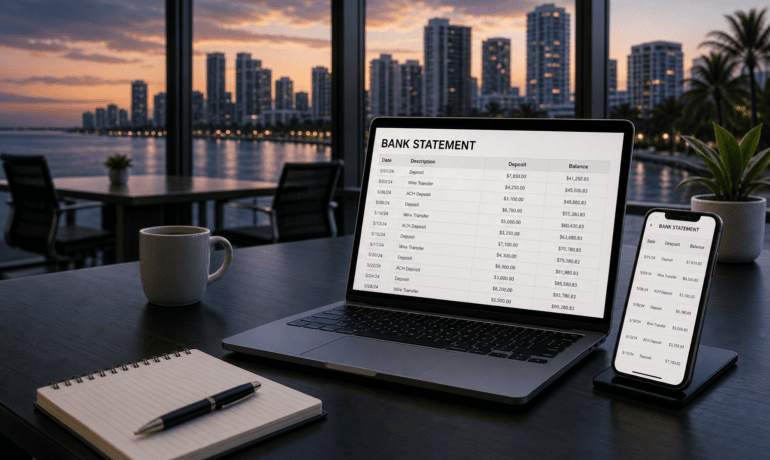
Money must be traceable before it can close. A US account makes wires faster and cheaper, but an international account works when its statements are clean. Lenders want the down payment seasoned — sitting in the same account for about two months — plus a paper trail for any large recent transfer. A reference letter from your home bank, or an international credit report, stands in for a US credit score.
Personal name or US LLC?
Many foreign investors take title through a Florida LLC for liability protection and simpler shared ownership. Lenders close foreign national loans in LLCs routinely; the file just adds three papers — articles of organization, an operating agreement, and the EIN. The structure you pick can also change taxes at the exit, so decide with a cross-border CPA before the contract, not after. This article is general information, not tax advice; we coordinate with cross-border CPAs on every file.
How to sign and close from abroad
The closing package can reach you four ways, and the title company decides which it accepts:
- US embassy or consulate: sign before a US notarizing officer in your home country — accepted everywhere, but appointments book out.
- Apostille: sign before a local notary and attach an apostille under the Hague Convention — the workhorse for most of Latin America.
- Power of attorney: one apostilled POA lets a trusted signer in Florida execute the rest of the package.
- Remote online notarization: Florida authorizes online notaries for many documents — ask early whether your title company will take it.
Confirm the signing plan the same week you go under contract. Run your numbers just as early with our DSCR calculator.
A typical deal
An engineer in Lima buys a $310,000 rental condo in Kendall. Her passport and LLC papers are ready, and her ITIN application is filed the week the contract is signed. The down payment has sat in her Miami account for a year — no sourcing questions. Her foreign national loan closes on a 1.15 DSCR, she signs the package before a Lima notary with an apostille, and the deal records thirty-one days after the offer. She never leaves Peru.
Ready to close from abroad?
Alpha Equity Lending walks foreign investors through this exact checklist on every file — passport to apostille, ITIN timing to LLC setup. Tell us about your purchase through our submit your deal page and we will build your document list before you sign — in English or Spanish.
By Andres Jara — Alpha Equity Lending (NMLS #1855083). 20+ years in real estate finance, an MS in Finance, and an active South Florida investor and landlord.
